Results for: “
SaaS
“
AI Is Breaking the Venture Funding Ladder and Raising the Bar for Software M&A (Part II)
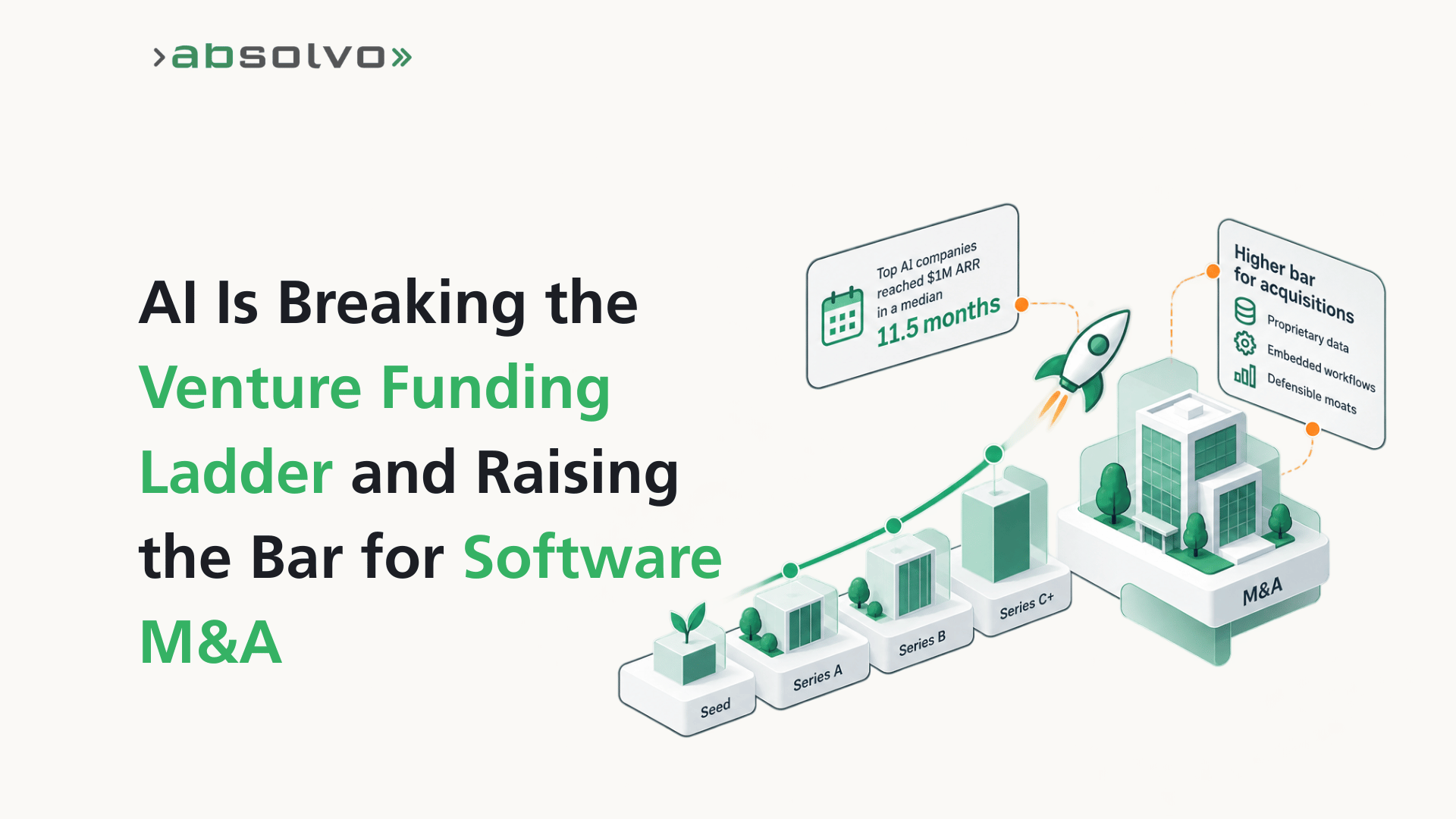
Historically, the venture path was relatively predictable: Seed funded the team and product, Series A signaled early product-market fit, Series B funded repeatable go-to-market and scale, and M&A typically came later — after years of product development, capital investment and organizational build-out.
AI is compressing that journey.
Series A is becoming a weaker maturity signal for software
According to Stripe, its top 100 AI companies reached $1M in annualized revenue in a median 11.5 months, around four months faster than the fastest-growing SaaS companies at the height of the subscription boom. Younger AI businesses reached major revenue milestones roughly three times faster than companies founded before 2020.
The efficiency can be equally striking. Bessemer Venture Partners’ high-growth AI “Supernovas” generated around $1.13M of ARR per employee, four to five times its traditional SaaS benchmark, although their roughly 25% average gross margin also shows that rapid growth does not automatically mean durable economics.
At the same time, valuations are moving earlier. PitchBook puts the median US AI Series A pre-money valuation at $54.9M in 2025 versus $40.2M for non-AI companies, a roughly 37% premium for the typical AI company, not just the standouts, paid before investors can reliably tell future winners from laggards
For founders, particularly in application-layer businesses with healthy margins, this weakens the logic of the traditional funding ladder. If a seed round can take a company much further with less headcount and lower burn, another financing round, and another meaningful dilution event, becomes less automatic. (The exception is AI companies with thin margins or heavy compute costs, which often need more capital, not less.)
For investors, the problem is almost the reverse: companies can become expensive before retention, repeatable GTM, switching costs and a durable moat are fully proven. Series A can therefore become an awkward risk/reward point, already too expensive to invest cheaply, but still too early to know who the winner is.
Where funding and M&A meet
The same force that makes startups cheaper to build can also make them less valuable to acquire. If AI allows a buyer to recreate most of a product faster and with a smaller team, the obvious question becomes: why buy it rather than build it?
If the value sits mainly in a replaceable interface, that question becomes harder to answer. If the business controls a system of record, proprietary data or deeply embedded workflows, the equation is different: code can be rebuilt, but years of data, integrations, customer relationships and workflow depth cannot.
That is why AI can simultaneously create more startups and a higher M&A bar. SaaS M&A remains very active: Software Equity Group recorded 2,784 transactions on a trailing-twelve-month basis through Q2 2026, the highest level it has tracked. But the mix matters, the higher bar shows up in price rather than volume. Private SaaS M&A has been clearing at a 4.0x median EV/TTM revenue through mid-2026, and strategic buyers pay up mainly for assets adding proprietary data, AI capabilities, embedded workflows or mission-critical functionality.
Recent transactions make the valuation reset tangible. Airtable went from an $11bn+ valuation in 2021 to a $1.285bn enterprise value in 2026, while Miro went from $17.5bn in 2022 to $1.355bn enterprise value, despite Airtable still growing ARR above 20% to approximately $480 million and Miro generating around $600 million of ARR. Part of that gap reflects the end of zero interest rates: 2021–22 valuations were set at peak liquidity, and most software has since de-rated. But pricing both at under 3x ARR also says something about strategic value. These are widely used collaboration tools, but they sit closer to the interface than to the system of record.
Funding-round valuations and acquisition prices are not directly comparable, but the direction is clear: today's buyers apply a much tougher test of strategic scarcity.
Capital has not disappeared; it has become more selective and is being reallocated. Higher-for-longer interest rates have raised the cost of financing acquisitions, particularly for leveraged private equity buyers, while unprecedented spending flows into AI infrastructure and internal development For CEE software businesses, perceived country risk and smaller scale can add another hurdle, especially where AI defensibility is uncertain. Acquisitions therefore need a stronger rationale: something a buyer cannot efficiently build itself, at a price that justifies the combined risks.
CEE Software Exits: The Market Has Moved
CEE VC funds raised €832M in 2021 and €708M in 2022, according to Invest Europe. As those vintages mature, exit expectations shaped by abundant liquidity, low rates and pre-AI software economics need reassessing. Regional portfolios include many marketing, content and productivity tools that may not match buyers’ demand for mission-critical software. In our deals and buyer discussions, interest does not necessarily translate into prices shareholders expect. Longer holding periods raise the hurdle for delivering returns that justify venture’s risk and illiquidity.
In today’s selective and rapidly changing M&A market, exit strategy has never been more important.
Conclusion: what can the buyer not rebuild?
AI is changing both sides of the same equation. For founders, it can reduce the capital required to reach scale and make the traditional Seed → A → B progression less automatic. For buyers, it lowers the cost of recreating functionality, raising the threshold for what deserves a strategic premium.
That increasingly pushes M&A toward a barbell: At one end are early acquisitions for differentiated technology, talent or data, such as Google's roughly $2.4 billion licensing-and-hiring deal with Windsurf in 2025, at the other are scaled, deeply embedded strategic assets, such as Thoma Bravo's $12.3 billion acquisition of Dayforce.
The difficult place is the middle: good software with some revenue, but insufficient scale and no clear answer to whether it is a system of record or a replaceable interface.
Because increasingly, the M&A question is simply: what has this company built that the buyer cannot recreate itself?
AI Is Redrawing the Software Map (Part I): System of Record vs. Replaceable Interface
The horizontal premium has disappeared
For years, horizontal software commanded the premium: larger TAMs, cross-industry applicability and platform potential. Vertical software was considered narrower, despite businesses such as Bloomberg, Veeva or Synopsys demonstrating the value of proprietary data, deep workflows and high switching costs.
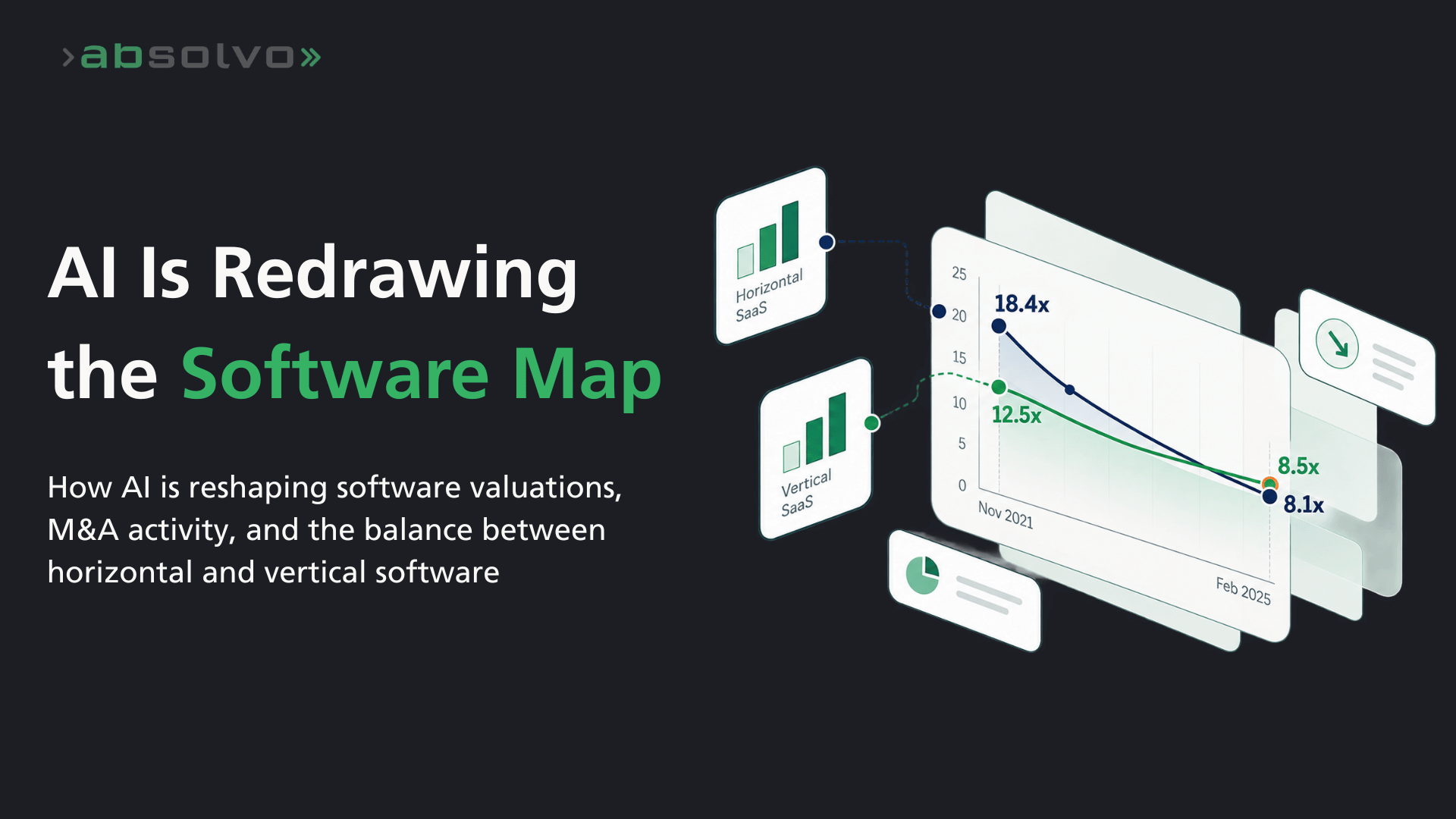
That hierarchy has changed dramatically. According to Blackpeak Capital’s March 2025 SaaS Sector Update, horizontal SaaS traded at 18.4x forward revenue versus 12.5x for vertical SaaS at the November 2021 market peak. By February 2025, the two had converged at 8.1x and 8.5x. Much of the compression reflected higher interest rates and the broader SaaS reset rather than AI alone. But horizontal software fell much harder than vertical peers, ~56% versus ~32%, suggesting that breadth alone was no longer enough to command a premium. This suggests investors were already repricing breadth and paying for depth.
M&A deal mix shows a similar shift: in Q2 2026, vertical software represented 54% of SaaS transactions, up from 46% a year earlier according to Software Equity Group. Buyers increasingly favored specialized workflows, proprietary data and mission-critical functionality.
CEE lacks a comparable dataset, but specialist vertical consolidators are increasingly active in the region, with several international acquirers completing multiple deals across CEE over the past two years. Acquirers such as Everfield, Vesta Software Group, Hawk Infinity, Shop Circle and Valsoft are increasingly active, and we see that interest first-hand: several consolidators approach us directly to discuss opportunities and attend our events to build local relationships.
But systems of record are fighting back
AI initially seemed to reinforce the vertical thesis: generic functionality becomes cheaper to reproduce, while industry-specific data and workflows remain hard to replicate. Yet the first AI-driven software sell-off hit some of the most entrenched systems of record in the market. In early February 2026, a $285bn market rout was triggered by Anthropic's release of enterprise plugins for its Cowork AI agent platform. For instance: Salesforce, ServiceNow, Adobe, and Workday each dropped around 7% in a single day. Investors feared that agents could undermine seat-based pricing and absorb workflows previously monetized by standalone applications.
Since then, that view has become more nuanced. Parts of enterprise software have rebounded as investors started distinguishing between replaceable interfaces and embedded systems of record. ServiceNow's Q2 results showed AI-related annual contract value above $1 billion, subscription revenue up 24% and renewal rates of 98%. Workday rallied on reports that Silver Lake had entered discussions to acquire the company, with Morgan Stanley saying a deal would validate Workday's moat. Salesforce jumped 22% on 27 August after its second-quarter results, its second-best day ever. The move was helped by improving growth and confidence that it can remain a critical data and orchestration layer beneath AI agents. (Not all of the rebound was fundamental: part of it reflected money flowing out of chip stocks back into software stocks.)
The logic is straightforward: an AI agent may become the interface for approving an invoice, generating a forecast or hiring someone, but it still needs trusted data, permissions, integrations, auditability and somewhere to execute the action. A basic CRM or dashboard can increasingly be built in days; years of enterprise data and embedded workflows cannot.
The more useful dividing line is therefore becoming system of record vs. replaceable interface, rather than horizontal vs. vertical.
The same question applies to vertical software
Constellation’s shares fell roughly 50% from their June 2025 peak to late January 2026, as investors grappled with both AI disruption concerns and uncertainty following founder Mark Leonard’s departure. The operating picture has been more nuanced: Q2 2026 revenue grew 17%, but organic growth was only 3%, with acquisitions driving most of the increase. Importantly, management said AI had not yet materially affected revenue growth in either direction, although it was already improving development productivity.
Has the AI-disruption thesis been applied too broadly? A niche vertical ERP deeply embedded in an industry may have more in common with SAP than with a generic point solution. Veeva, for example, rallied in August once the expected AI threat to its niche failed to materialize. But not every vertical app is a system of record, and thin industry tools face the same pressure as horizontal ones.
Conclusion: follow the data and the workflow
The first AI thesis was simple: if software becomes easier to build, software becomes less valuable. The emerging reality is more selective. Products whose moat is mainly the interface or the cost of writing the code are under pressure. Businesses controlling trusted data, critical workflows, permissions and customer relationships may remain highly defensible — whether horizontal or vertical.
So the key question is no longer: horizontal or vertical? It is: system of record or replaceable interface? In practice, that is a spectrum rather than a binary. Put more simply: what has this business built that cannot easily be recreated?
That distinction is increasingly shaping both software valuations and strategic buyer behavior. As Part II explores, it is also reshaping venture funding and raising the bar for M&A.
Software Consolidators Insights: An Emerging Exit Route for CEE Tech Companies
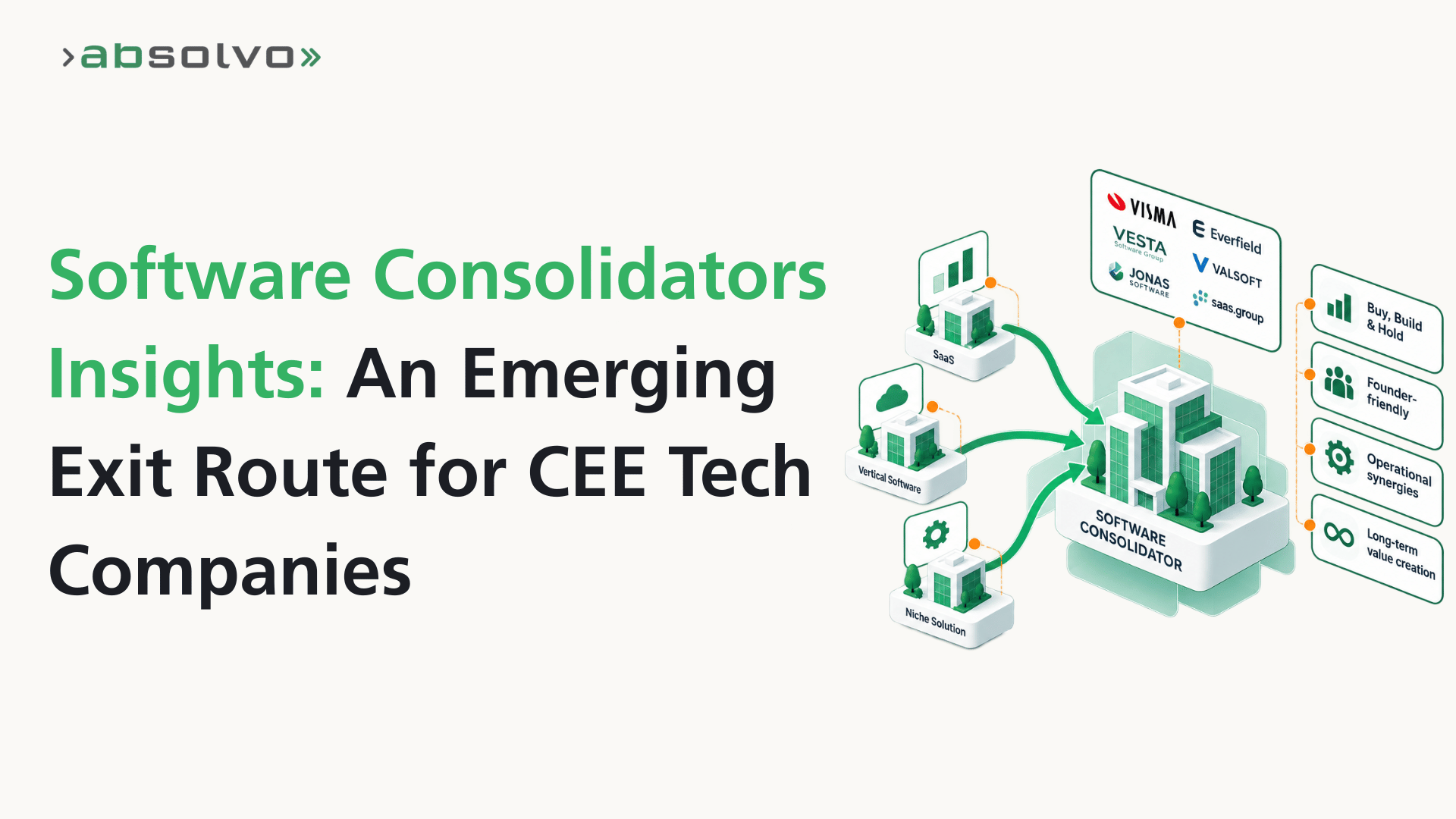
Software consolidators that have been active across North America and Western Europe are increasingly turning their focus to CEE region. As Absolvo successfully closed deals with them (and negotiating more continuously), we see growing interest from leading global and European software consolidators – including Jonas Software, Everfield, saas.group Visma, Vesta Software Group, Abingdon, Valsoft, Shop Circle, Balio and others – actively targeting Europe as well as the CEE and SEE markets. We maintain ongoing dialogue with these buyers, exploring new opportunities in the region’s fast-maturing software ecosystem.
What Defines a Software Consolidator
Software consolidators differ fundamentally from traditional private equity (PE) firms or strategic buyers. They operate under a Buy, Build & Hold philosophy, i.e. acquiring, and developing vertical software and SaaS companies to create sustainable long-term value rather than short-term financial returns.
Their focus areas include:
- ARR stability and recurring revenues. They target companies with predictable cashflows, high retention, and strong customer lifetime value. Low churn is key! Check your industry average, should you be better than the others, that can be valuable.
- Founder-friendly approach that offers flexible transition plans, keeping management teams in place, and ensuring cultural continuity.
- Operational efficiency, centralising finance, HR, and IT; leveraging cross-portfolio synergies; and driving scalability across fragmented markets. Because they are usually backed by permanent capital (in some cases publicly listed companies), consolidators can hold assets indefinitely, prioritising operational excellence and organic growth over time
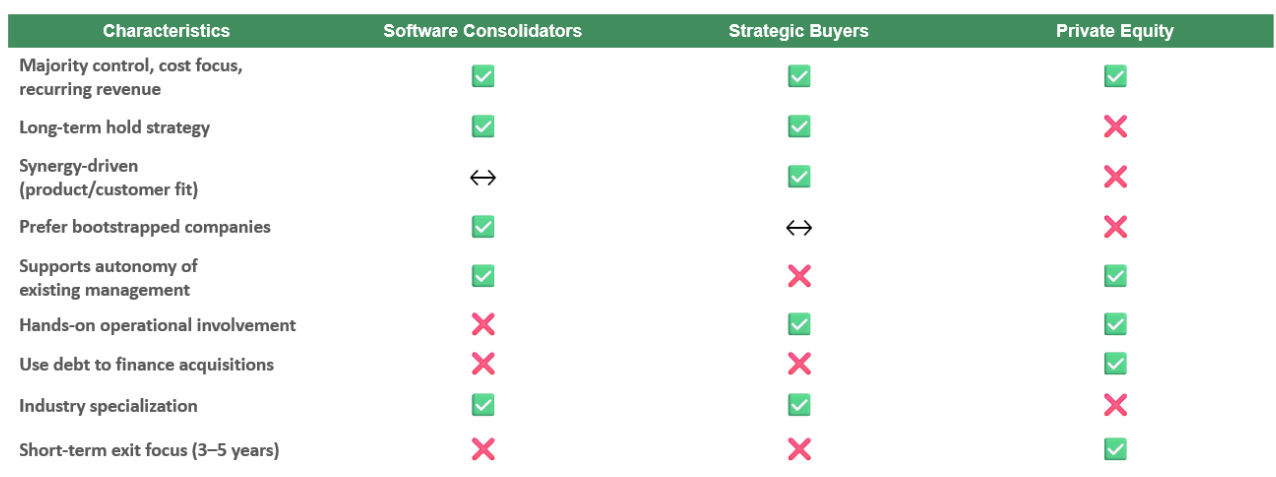
How Consolidators Differ from PE and Strategic Buyers
Founders or VCs considering an exit should understand the three key buyer types in SaaS M&A:
- Private Equity (PE): financial investors aiming for leveraged growth and a 3–5-year exit horizon.
- Strategic Buyers: larger software or IT groups acquiring for technology or customer synergies, often integrating targets into existing structures.
- Software Consolidators: permanent owners who combine the operational discipline of strategics with the agility and speed of financial investors. They offer continuity, stability and partnership for founders.
Tailoring your transaction story and financial narrative to these buyer profiles is critical to maximising value and closing a deal that aligns with your goals.
Ideal Targets for Software Consolidators
From Absolvo’s transaction experience, several attributes define the “sweet spot” for consolidators when evaluating acquisition targets in Europe and CEE / SEE:
- Predictable recurring revenues: consolidators favour SaaS or software-license models with high retention rates and typically €2-10 million ARR size (some might pursue larger deals), or from 500k-1million EBITDA
- Vertical or niche market leadership. Companies serving a well-defined vertical segment – with strong product-market fit, established brand reputation and defensible customer relationships – are preferred over generalist or horizontal platforms. However, they are such serial acquirers who rather look for min 15-20% ARR growth and horizontal, global solutions. Meaning should you be a rather local or regional software business, or a SaaS company with customers all around the world, these investors can be equally an option too.
- Most consolidators seek EBITDA-positive businesses, valuing stable cashflows over hyper-growth, while part of them are not keen on short term EBITDA but ARR growth.
- Strong teams and founder continuity: transactions often allow founders or key managers to leave (even immediately) or remain involved post-deal. Leadership continuity and a collaborative mindset are viewed as core to integration success.
Why Europe and the CEE Region Are in Focus
The consolidation trend is no longer confined to Western Europe. In recent years, we see CEE and SEE emerging as strategic growth regions for global consolidators.
Absolvo’s experience highlights three drivers:
- Attractive valuations: CEE SaaS firms often trade below Western European multiples despite strong retention and solid ARR.
- Fragmented market structure: ideal for roll-ups and operational integration.
- Proven founder quality: the region has a deep pool of experienced founders who have built profitable, global-focused / export-ready SaaS companies
Recent regional examples include Smartbill’s acquisition by Visma or Vesta Software Group’s acquisition of ArenimTel – that was solely advised by Absolvo. These transactions illustrate the sweet spot for consolidators: stable, recurring-revenue businesses with loyal customer bases and vertical expertise.
AI Integration and Its Growing Role in SaaS M&A
The impact of AI on software transactions is increasingly visible. Consolidators now assess how AI enhances a target’s efficiency, product roadmap, or data strategy. For founders preparing to sell, articulating a credible AI vision can significantly boost buyer interest and valuation.
Transaction Dynamics and Valuation Insights
Software consolidators maintain dedicated in-house M&A teams, allowing them to evaluate opportunities efficiently and move swiftly once interest is established. They avoid bidding wars but are willing to pay competitive valuations for high-quality assets with transparent metrics and recurring revenue visibility.
Based on our experience, they are quick in assessing the targets, able to provide an LOI in 2-3 weeks. The chance of closing a deal is extremely high, they understand what they want and once Parties find common ground, they move quickly – that is highly preferred by the CEE entrepreneurs also.
Founders with a clear, well-structured transaction story, clean financial data, and defensible ARR metrics tend to achieve stronger outcomes, even within consolidators’ disciplined valuation frameworks.
The vertical software integrators prefer all cash deals, which may not be the case when it comes to mid-market strategic buyers (where founders may get stocks). Therefore, these software buyers can be a good option for VC-backed tech companies also.
Absolvo’s Role in the CEE/SEE SaaS M&A Ecosystem
Through our direct relationships with leading consolidators across Europe and beyond, we help founders:
- Understand buyer logic and value drivers
- Prepare financials and KPIs that resonate with investors
- Communicate growth, scalability effectively
- Navigate deal structures that result in better deal outcomes