Results for: “
Software consolidators
“

Breakout CEE Tech Exits: How to Sell Your Company for More Than It’s ‘Worth’
Many CEE tech company shareholders may be leaving money on the table as some exits have the potential to reach up to 2-5x fair market value. It’s not a myth; we’ve seen it happen firsthand. A big reason tech exits matter now is that many VCs who invested in 2019-2021 are facing portfolio companies that couldn’t raise a new round in 2023-2024, so the focus is shifting from “raise again” to “exit well.” In a world without free money, premiums aren’t paid for hype, or AI promises alone, especially in CEE where international expansion often delays profitability.
This dynamic is not limited to VC-backed companies. Bootstrapped founders face the same situation, and they are equally positioned to achieve premium outcomes when properly prepared. However, these outcomes are not created at the moment of exit, so founders need to start preparing early, ideally 2-3 years before launching a formal exit process. To completely understand how early preparation drives premium outcomes, we need to step back for a moment – every good story has a beginning.
And in this case, it starts in 2021, a year that felt a bit like the “gold rush” of modern M&A. Capital was cheap, interest rates were near zero, and money moved faster than ever. Ultra-low financing costs and booming equity markets created a perfect storm of aggressive spending and rapid-fire dealmaking, pushing global M&A activity to record highs.
The sobering came quickly. By 2022, global M&A value had dropped roughly 37% year-on-year, a sharp wake-up call for the entire market.
The reasons behind this 37% global M&A value drop hit from every direction:
- inflation spiked
- interest rates climbed rapidly
- financing costs surged
- bid-ask spreads widened as tech valuations fell
- geopolitical shocks rattled boardrooms
On the deal level, the cracks were just as visible:
- PE firms shifted from buying mode to repair mode
- several high-priced strategic buyers’ acquisitions from 2020-21 underperformed
- write-downs followed
- executives behind “big cheques” were put under the spotlight
- boards grew cautious on anything not supported by facts and looked like overpaying
The brakes weren’t just tapped – they were slammed. The free-money honeymoon was over, and it hasn’t returned since. Yet the story doesn’t end with a long winter.

Why the Recent M&A Upswing Could Favor CEE Tech Founders
Fast-forward three years, and as we head into 2026, that caution is still present – especially among strategic buyers who remain more selective than their financial counterparts. Still, the ice is undeniably thawing. Forecasts point to a cautiously optimistic rebound in global M&A of roughly 25% year on year, and we feel it too: buyer's appetite is picking up, dialogues are reopening, offers are improving, and momentum is gradually returning.
And when we zoom in on CEE, the picture becomes even more interesting. The talent is world-class – exceptional developers, strong engineering culture, and a vibrant innovation mindset – yet many firms still operate below the scale where valuation formulas turn generous. Years of pouring resources into product and market expansion often mean they haven’t reached the efficiency or size needed to command strong ARR multiples. And while the products themselves are impressive, many CEE tech companies struggle to fully unlock their commercial potential.
This is where the idea of a “tech exit” steps into the story. Not every company can be a market leader, and not every business reaches the level of profitability or economies of scale that trigger automatic premium valuation. In many cases, you’re not selling “amazing EBITDA” today, but the proven fundamentals and credible path to reach it. Yet CEE founders – with their talent, resilience and engineering excellence – deserve outcomes that rival those in more mature markets. To get there, however, they often need to follow a different path.
And that path does not begin when founders feel tired and decide they finally want to sell. At that point, it’s usually too late. The companies that secure the strongest valuations are the ones that start preparing long before a process officially begins – ideally 2-3 years earlier.
But how do you convince the same strategic decision-makers who got burned by overpaying 4-5 years ago to still pay a 2-3-5x premium above fair value today? Early positioning, disciplined financials, and validated synergies are among the foundational pieces that unlock premium offers. They are the difference between an average deal and a standout result in today’s CEE investment environment.
The 8 Exit Readiness Factors That Separate Breakout Deals from Average Ones
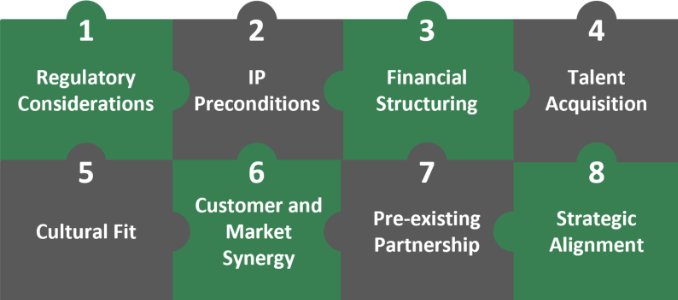
So, what does “real preparation” actually look like? We’ve distilled it into 8 critical factors that repeatedly decide whether a company lands at fair value or earns a premium. In practice, that premium isn’t negotiated with the buyer company, but with the people inside it, each with their own motivations and priorities. Want to learn what those stakeholders care about and how to navigate them? Read more here:
- Regulatory considerations: Preparing for FDI approvals and competition scrutiny is key, especially as engaging with strategic buyers early can expose sensitive information if not carefully managed but also may have impact on timing (can cause months of delay).
- IP preconditions: Clean, defensible and transferable IP in every tech deal is critical, particularly in high-barrier or fast-evolving markets where buyers place a premium on protected innovation.
- Financial structuring: Further financial deal terms matter as much as headline price, and many M&A deals include a purchase price adjustment mechanism, earn-out component or other solutions to gap valuation debates. Also, you need to decide in advance if you’re optimizing revenue growth or EBITDA.
- Stable team and contracts: A committed team with limited key-person risk and strong contractual foundations help ensure continuity and reduce post-transaction uncertainty.
- Cultural fit: Cultural alignment remains a key success factor, with 95% of executives considering it critical for smooth integration. For the founders and management this is also key: its about deciding where you and your team will belong the day after closing.
- Customer and market synergy: Clear upside potential through cross-sell; upsell and strong retention metrics can significantly enhance perceived value. Strong synergies can take the deal into different horizons.
- Pre-existing partnerships: “Try-before-you-buy” M&A, where partnerships and integrations set the stage for acquisition, paving the way for a breakout tech exit.
- Strategic alignment: Buyers are driven by different priorities, from market expansion to capability acquisition, so alignment across product, technology and strategy is essential.
If this topic has sparked your interest, you can explore deeper insights in the downloadable content on the right. Created by Absolvo’s experts, the material is designed specifically for tech founders preparing for a breakout exit.
.jpg)
Software Consolidators Insights: An Emerging Exit Route for CEE Tech Companies
Software consolidators that have been active across North America and Western Europe are increasingly turning their focus to CEE region. As Absolvo successfully closed deals with them (and negotiating more continuously), we see growing interest from leading global and European software consolidators – including Jonas Software, Everfield, saas.group Visma, Vesta Software Group, Abingdon, Valsoft, Shop Circle, Balio and others – actively targeting Europe as well as the CEE and SEE markets. We maintain ongoing dialogue with these buyers, exploring new opportunities in the region’s fast-maturing software ecosystem.
What Defines a Software Consolidator
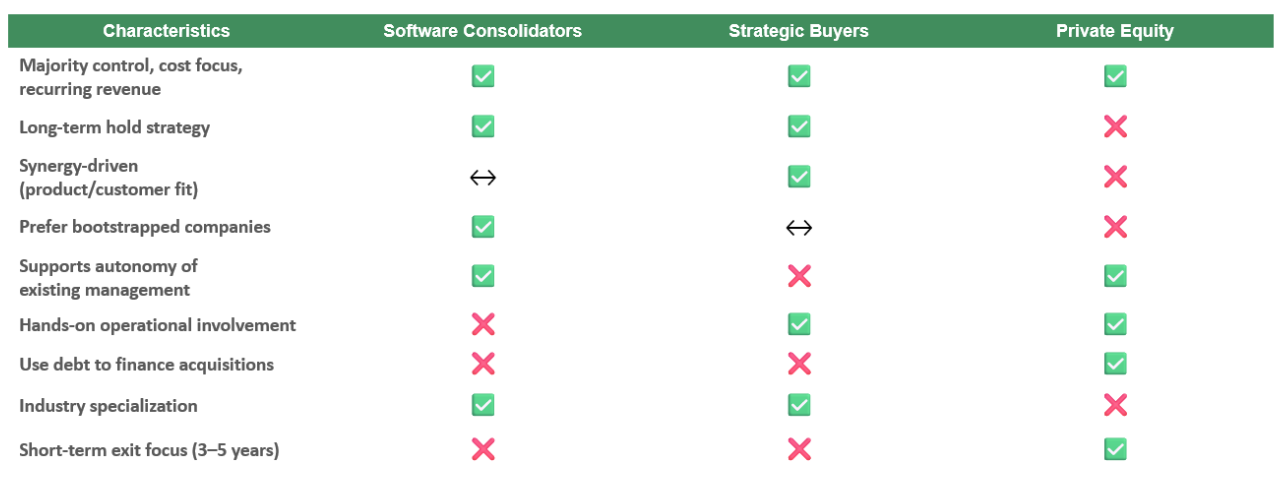
Software consolidators differ fundamentally from traditional private equity (PE) firms or strategic buyers. They operate under a Buy, Build & Hold philosophy, i.e. acquiring, and developing vertical software and SaaS companies to create sustainable long-term value rather than short-term financial returns.
Their focus areas include:
- ARR stability and recurring revenues. They target companies with predictable cashflows, high retention, and strong customer lifetime value. Low churn is key! Check your industry average, should you be better than the others, that can be valuable.
- Founder-friendly approach that offers flexible transition plans, keeping management teams in place, and ensuring cultural continuity.
- Operational efficiency, centralising finance, HR, and IT; leveraging cross-portfolio synergies; and driving scalability across fragmented markets. Because they are usually backed by permanent capital (in some cases publicly listed companies), consolidators can hold assets indefinitely, prioritising operational excellence and organic growth over time
How Consolidators Differ from PE and Strategic Buyers
Founders or VCs considering an exit should understand the three key buyer types in SaaS M&A:
- Private Equity (PE): financial investors aiming for leveraged growth and a 3–5-year exit horizon.
- Strategic Buyers: larger software or IT groups acquiring for technology or customer synergies, often integrating targets into existing structures.
- Software Consolidators: permanent owners who combine the operational discipline of strategics with the agility and speed of financial investors. They offer continuity, stability and partnership for founders.
Tailoring your transaction story and financial narrative to these buyer profiles is critical to maximising value and closing a deal that aligns with your goals.
Ideal Targets for Software Consolidators
From Absolvo’s transaction experience, several attributes define the “sweet spot” for consolidators when evaluating acquisition targets in Europe and CEE / SEE:
- Predictable recurring revenues: consolidators favour SaaS or software-license models with high retention rates and typically €2-10 million ARR size (some might pursue larger deals), or from 500k-1million EBITDA
- Vertical or niche market leadership. Companies serving a well-defined vertical segment – with strong product-market fit, established brand reputation and defensible customer relationships – are preferred over generalist or horizontal platforms. However, they are such serial acquirers who rather look for min 15-20% ARR growth and horizontal, global solutions. Meaning should you be a rather local or regional software business, or a SaaS company with customers all around the world, these investors can be equally an option too.
- Most consolidators seek EBITDA-positive businesses, valuing stable cashflows over hyper-growth, while part of them are not keen on short term EBITDA but ARR growth.
- Strong teams and founder continuity: transactions often allow founders or key managers to leave (even immediately) or remain involved post-deal. Leadership continuity and a collaborative mindset are viewed as core to integration success.
Why Europe and the CEE Region Are in Focus
The consolidation trend is no longer confined to Western Europe. In recent years, we see CEE and SEE emerging as strategic growth regions for global consolidators.
Absolvo’s experience highlights three drivers:
- Attractive valuations: CEE SaaS firms often trade below Western European multiples despite strong retention and solid ARR.
- Fragmented market structure: ideal for roll-ups and operational integration.
- Proven founder quality: the region has a deep pool of experienced founders who have built profitable, global-focused / export-ready SaaS companies
Recent regional examples include Smartbill’s acquisition by Visma or Vesta Software Group’s acquisition of ArenimTel – that was solely advised by Absolvo. These transactions illustrate the sweet spot for consolidators: stable, recurring-revenue businesses with loyal customer bases and vertical expertise.
AI Integration and Its Growing Role in SaaS M&A
The impact of AI on software transactions is increasingly visible. Consolidators now assess how AI enhances a target’s efficiency, product roadmap, or data strategy. For founders preparing to sell, articulating a credible AI vision can significantly boost buyer interest and valuation.
Transaction Dynamics and Valuation Insights
Software consolidators maintain dedicated in-house M&A teams, allowing them to evaluate opportunities efficiently and move swiftly once interest is established. They avoid bidding wars but are willing to pay competitive valuations for high-quality assets with transparent metrics and recurring revenue visibility.
Based on our experience, they are quick in assessing the targets, able to provide an LOI in 2-3 weeks. The chance of closing a deal is extremely high, they understand what they want and once Parties find common ground, they move quickly – that is highly preferred by the CEE entrepreneurs also.
Founders with a clear, well-structured transaction story, clean financial data, and defensible ARR metrics tend to achieve stronger outcomes, even within consolidators’ disciplined valuation frameworks.
The vertical software integrators prefer all cash deals, which may not be the case when it comes to mid-market strategic buyers (where founders may get stocks). Therefore, these software buyers can be a good option for VC-backed tech companies also.
Absolvo’s Role in the CEE/SEE SaaS M&A Ecosystem
Through our direct relationships with leading consolidators across Europe and beyond, we help founders:
- Understand buyer logic and value drivers
- Prepare financials and KPIs that resonate with investors
- Communicate growth, scalability effectively
- Navigate deal structures that result in better deal outcomes